Project-based outsourcing is the process of outsourcing a vendor for a specific project from start to finish. The budget, goals of the project, and deadline are well established. Managed services and staff augmentation differ from Project-based outsourcing. Staff augmentation helps an organization in hiring outside talent to handle skills gaps or deal with extra work temporarily. Managed services are a type of outsourcing where a company hires another company to run its operations, like IT services, and provide ongoing support. Businesses use Project-based outsourcing to hire on a short-term basis, for specialized skills, or for one-time tasks. Examples are web and app development or starting a marketing campaign. It fit companies that have a fixed scope without any long-term commitment.
What Are the Stages of a Project-Based Outsourcing Lifecycle?
Here are the 7 stages of a project-based outsourcing lifestyle.
- Requirement Gathering & Scope Definition: Understand the needs of the business. Teams list out the project objectives, expected outcomes, features, and deliverables. This assists in defining a clear project scope and prevents confusion.
- Vendor Evaluation & Contracting: The vendors are shortlisted by organizations. Clients review their experience, previous work, and proposals. After identification of the appropriate partner, both parties sign a contract covering timelines, cost, and SLAs.
- Project Planning & Roadmap Development: An elaborate plan is developed, with milestones, timelines, resources, and communications. Roadmap development assists in ensuring that everyone is on track and responsible.
- Execution & Deliverable Production: Vendor begins the main work, which is either design, development, or production. The milestones are reviewed and updated to track the progress.
- Quality Assurance & Testing: The project undergoes a series of tests before the final delivery. Functional, performance, and user acceptance testing ensure that the output meets all quality standards.
- Final Delivery, Handover & Documentation: Once the project has been approved, the vendor delivers the completed project. They also offer documentation, transfer of knowledge, and training.
- Maintenance or Support (Optional Add-On): Some vendors also offer post-launch services. This involves technical support, bug fixes, updates, or performance enhancements.
What Types of Projects Are Best Suited for Project-Based Outsourcing?
The following are the 5 best projects used in project-based outsourcing.
- Software & App Development Projects: Project-based outsourcing is used for web and mobile app development, digital products, and the development of MVPs. Businesses outsource the development of software and applications to find experienced developers and deliver faster.
- Digital Transformation Projects: Projects such as cloud migration, automation setup, or ERP and CRM implementation are outsourced. They demand technical skills for a defined period.
- Creative & Marketing Projects: Companies outsource branding, user interface/experience design, advertising, and content creation. Outsourced teams provide new ideas, creativity, and deliver on time.
- IT Infrastructure or Cybersecurity Upgrades: Project-based Outsourcing enhances the network and security systems and facilitates data protection audits. This gives access to professionals without having to employ full-time employees.
- R&D and Prototype Development: Outsourcing is employed by companies to develop and test new products or technologies and to be innovative.
What Tools & Technologies Support Project-Based Outsourcing?
The following are the 5 tools and technologies that can facilitate project-based outsourcing.
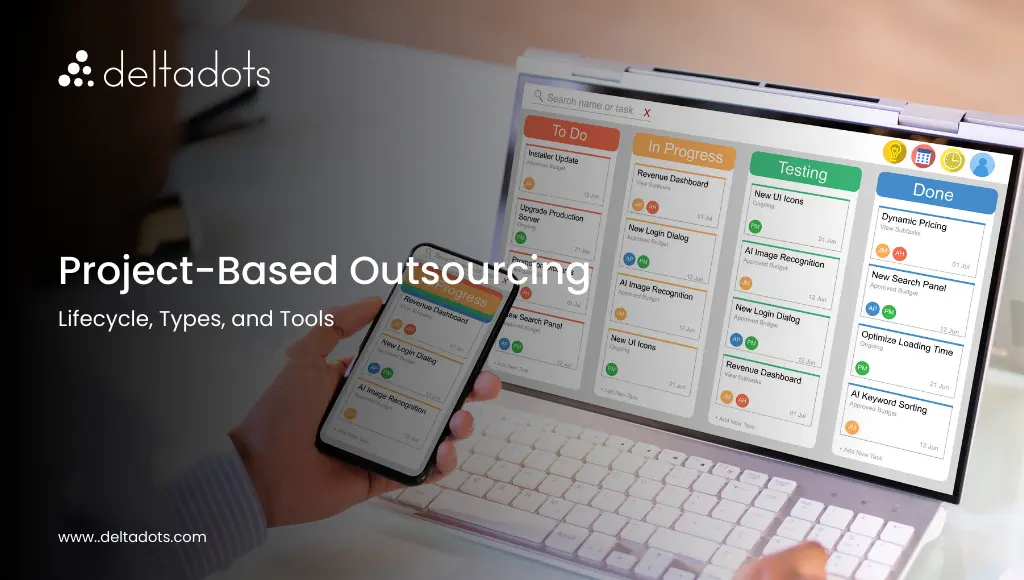
- Project Management Tools: The tools assist a team with planning, assigning, and tracking tasks, for example, Jira, Asana, Trello, and ClickUp. They simplify the process of controlling timelines, milestones, and project progress.
- Communication & Collaboration Tools: Slack, Microsoft Teams, and Zoom are platforms that help keep teams connected to each other. They facilitate fast communication, sharing of files, and virtual meetings in various time zones.
- Documentation & Version Control: Teams manage project documentation through tools like Confluence, GitHub, and Bitbucket. These tools allow easy collaboration among developers and customers.
- Quality & Testing Tools: The testing tools include Selenium, Postman, and TestRail. They are used in testing functionality and performance, and user experience, before final delivery.
- Time Tracking & Productivity: Toggl, Hubstaff, and Harvest are applications that track working hours and productivity. They give details on resource utilization and aid in proper billing.
What Is the Ideal Project-Based Outsourcing Engagement Model?
The 4 best project-based outsourcing engagement models are as follows.
- Fixed-Price Model: Project scope, timeframe, and budget are clearly defined from the start. Works well for projects that have well-documented requirements and are subject to minimal change. Businesses prefer this model for cost control and predictable results.
- Milestone-Based Payments: The payments are connected with specific milestones or deliverables of the project. Each phase is reviewed and approved before the next payment. This builds trust and ensures steady progress throughout the project.
- Hybrid Time & Material for Change Requests: Combines fixed prices with flexibility. The basic project has a fixed price, but any new features or changes requested are billed on time and resources used. This type of outsourcing is best for projects in evolution.
- PoC or Pilot Project Approach: This approach involves testing the vendor’s skill on a small scale. Gives an idea about the quality, communication, and reliability before actually starting the project. This engagement model reduces the risk and builds up confidence.
What Industries Commonly Use Project-Based Outsourcing?
Project-based outsourcing is applied in many industries such as technology and saas, retail, e-commerce, telehealth, banks, logistics, and media. Technology and SaaS companies outsource software and app development projects to save time and cost. Retail e-commerce and telehealth use project-based outsourcing to develop websites, apps, or platforms quickly and cost-effectively for specific goals.. Banks and financial firms use project-based outsourcing for security and analytics projects. The manufacturing and logistics companies use automation and ERP systems. Media and creative agencies use project-based outsourcing for design, video, and campaign projects. This helps industries save money, work faster, and access expert skills
How Do You Measure Success in Project-Based Outsourcing?
Here are the 5 ways to measure success in project-based outsourcing.
- On-time delivery vs project timeline: On-time delivery is completing projects on time. The project timeline shows if the project is going as per schedule. The timeline helps to find the late task or what slows down things. Meeting deadlines keeps the project smooth and builds client trust.
- Budget adherence and change request impact: Measures how much is spent as compared to the budget. Shows how well the budget is managed when the cost goes up or down. Change requests are changes that the client requests during the project. Each change is approved and checked for its cost and time impact.
- Quality of deliverables and defect rate: Good projects deliver high-quality results and meet client goals. Tests, reviews, and user feedback check the project’s quality. The defect rate shows how many mistakes or bugs are found. Fewer defects mean better work and careful testing.
- Client satisfaction and vendor performance score: Client Satisfaction shows how happy a client is with the project. Surveys and feedback measure the client’s happiness. Vendor performance score checks how well the vendor has performed. A good score means the vendor delivered quality work on time.
- ROI and time-to-value achieved from the project: ROI checks if the project’s budget aligns with the benefits. Success is measured by profit, saved costs, or new business growth. Time-to-value shows how quickly the project starts giving results. Faster value means quicker success for the business.