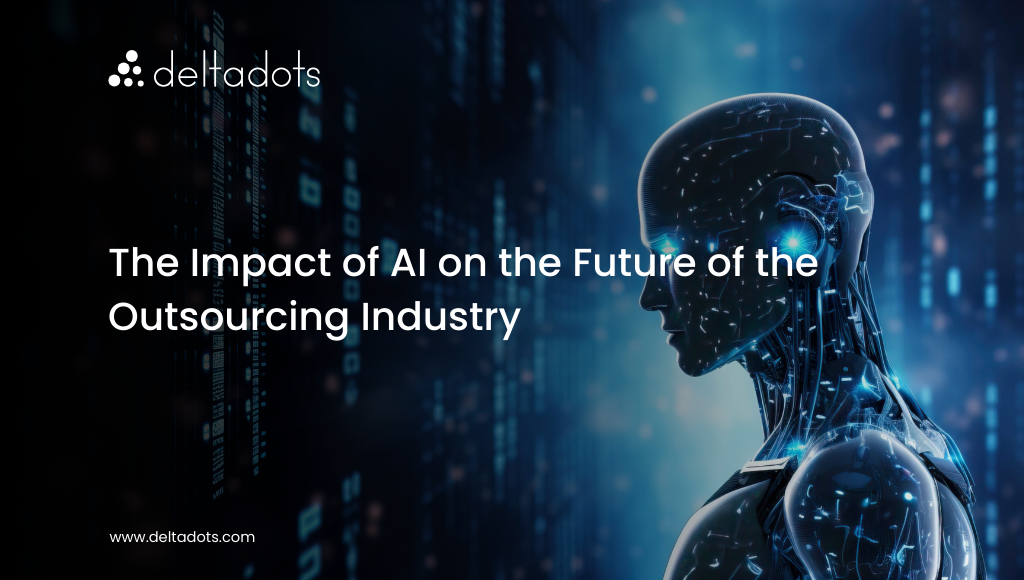
Outsourcing is the process of handling tasks and services to an external company or individual rather than doing the task in-house. AI is transforming outsourcing by efficiently automating repetitive activities, thereby reducing human errors. Data-driven decision-making is a result of analytics capabilities, which enhance decision-making through forecasting, performance management, and operational visibility. Businesses are benefited with reduced costs as AI streamlines the processes and reduces dependence on labor-intensive work, offering higher-quality services with faster responses and errorless activities. AI helps in improving agility and scalability; therefore, clients and outsourcing providers scale up fast and quickly respond to changing demands. This guide discusses how artificial intelligence is transforming outsourcing operations and business models. It describes key benefits and challenges, emerging trends, and guides organizations toward AI-driven outsourcing strategies to stay competitive.
What are the Key Areas Where AI is Transforming Outsourcing
The following are the key areas to transform AI outsourcing
- Customer Service Automation: Chatbots, virtual assistants, and AI-driven support handle routine queries, reduce human dependency, and improve response times.
- Business Process Outsourcing (BPO): AI is used to automate payroll, HR-related tasks, accounting, and back-office processing.
- IT and Software Development: AI helps develop coding, performs testing, improves system monitoring, and boosts security by providing predictive threat protection.
- Data Analytics & Insights: Data is processed automatically, predictive insights are gained, and decision-making is empowered with augmented analytics. Customer experience is optimized with Intelligent Agents.
- Supply Chain/ Logistics: AI is helping in efficient inventory management, procurement optimization, and demand forecasting to execute the operations efficiently and at a low cost.
What are the Strategies for Leveraging AI in Outsourcing
The following are the strategies for leveraging AI in outsourcing
- Start with Pilot Projects: It is important to test the tools of artificial intelligence in a low-risk area or project before adopting them on a larger scale.
- Combine Human + AI Efforts: Use AI to support and enhance skilled staff, not fully replace human expertise.
- Select AI-Compatible Vendors: Choose the outsourcing vendors that have strong AI solutions and implementation expertise.
- Implement Continuous Monitoring: Monitoring AI systems regarding accuracy and effectiveness is crucial to ensure continued improvement.
- Invest in Training: Train employees on the use of AI tools. This increases employee efficiency, productivity, and skills.
What are the Tools and Technologies Driving AI Outsourcing
The following are the tools and technologies driving AI outsourcing
- AI-Powered Chatbots: Automate customer support, handle routine inquiries, and improve response time.
- Robotic Process Automation (RPA): Automates repetitive business processes with increased speed, accuracy, and operational efficiency.
- AI Analytics Platforms: Power BI and Tableau with AI modules offer advanced analytics, forecasts, and data-driven decisions.
- Predictive Maintenance Systems: AI is used to foresee failures in IT infrastructure and supply chains. This helps reduce downtimes and maintenance costs.
- Natural Language Processing (NLP): NLP allows computers and electronic devices to recognize, process, interpret, and generate speech and text using a combination of computational linguistics, rule-based models of human language, statistical modeling, machine learning, and deep learning.
How to Measure the Impact of AI on Outsourcing Performance
Measure the impact of AI by analyzing the rates of automation and the efficiency of the tasks that are automated. Analyze the cost savings and the return on investment that result from integrating AI into operations. Evaluate the impact of AI on the accuracy of tasks and the number of operational errors that are reduced. Assess the impact of AI on the employees’ productivity and the extent to which they perform value-added tasks. Check the impact of AI on the level of customer satisfaction and engagement.
What are the Challenges and Risks of AI in Outsourcing
The challenges and risks of AI in outsourcing are the following.
- High Upfront Cost: AI implementation has a high initial cost in terms of tools, infrastructure, and integration.
- Skill Gap: The implementation of effective AI management requires talented and AI-literate staff.
- Data Privacy Issues: AI outsourcing adheres to international data protection laws, such as GDPR, to minimize legal and security risks.
- Resistance to Change: The internal teams or the vendors are resistant to AI implementation, slowing the implementation process and preventing the maximum benefits.
- Over-Dependence on Technology: An Over-dependence on AI causes an error in predictions or automation when there is no human supervision.
What are the Future Trends in AI-Driven Outsourcing
The AI-driven outsourcing includes hyperautomation to automate the complicated processes and decrease the number of people involved in performing tasks. The AI-enhanced decision support is more insightful, quicker, and data-driven. Global AI Talent is becoming more and more integrated into organizations by companies to have access to specific skills and expertise. Ethical AI and Governance make sure that AI is ethically used and at the same time compliant and transparent. The collaboration between human beings and AI is increasing, and strategic thinking and intelligent automation are achieving results.