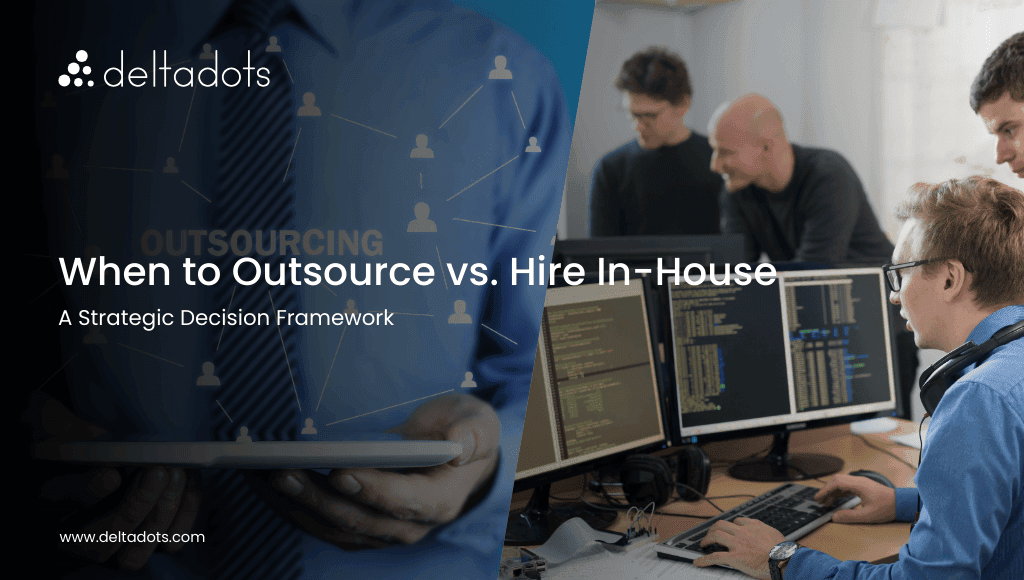
An in-house model means a company performs all the work internally, utilizing its own staff, tools, and resources. It provides more control, facilitates easy communication, and fosters good teamwork. However, it is also more expensive because the company has to hire and train its own people. The outsourcing model refers to assigning the work to another company. This is usually cheaper and quicker, because the company does not have to spend on hiring, training, or buying extra tools. One disadvantage of outsourcing is that the company has less control, and it becomes harder to check every detail of the outsourced project. Business operations are impacted depending on the chosen strategy, such as outsourcing or in-house. It affects overall costs, project speed, and the expertise of the team. A wrong decision results in increased cost, slower project progress, and resource wastage. A smart decision helps an organization optimize resources and facilitates growth. This guide is helpful for businesses in determining whether to outsource or handle tasks in-house. It offers a framework for comparing expenses, skills, growth needs, and day-to-day activities. It also includes procedures, helpful advice, and examples to determine the best functional model.
What are the Key Factors to Consider When Deciding
The following are the key factors to consider when deciding on a strategic framework.
- Cost Implications: Salaries, benefits, and training costs are the crucial factors that compare outsourcing fees with in-house setup expenses. Outsourcing is opted for short projects, while in-house hiring is suitable for long projects.
- Skill Availability: Skill decisions are based on cost, required expertise, and project timeline. Companies need to hire and train staff for in-house models, whereas external vendors provide the required specialization for faster initiation of the project.
- Time-to-Market: In-house work is influenced by quality and resource availability, considering that companies manage staff and resources themselves. Outsourcing meets fast demand and competition since external vendors immediately provide skilled resources.
- Control and Collaboration Needs: In-house teams provide full control and make collaboration easier. Outsourcing reduces direct control and makes collaboration harder because the work is done by external teams.
- Scalability and Flexibility: It is the ease with which the operations scale up or change. In-house teams take time and are costly to scale up or adapt. Outsourcing allows companies to rapidly adjust resources and handle changes without extra hiring or training.
- Confidentiality and Security: The key measures include access controls, encryption of data, and training of employees. Auditing and compliance are regularly performed with very minimal data breaches. In-house teams maintain all sensitive information in the company for better control. Outsourcing entails risks, hence companies keep vendors under strict security and privacy.
When to Outsource vs. Hire In-House
- Outsource: The tasks that require specialized expertise not available in the company are best handled through outsourcing. It is effective for projects that are short-term or frequently changing. Outsourcing is commonly used in companies for cost-sensitive tasks such as IT, marketing, payroll, or design. It allows the companies to save money and receive expert support.
- Hire In-House: Core functions that support long-term strategy are best supported by hiring in-house. This is best for tasks that require close teamwork and fast decisions. The in-house staff handles sensitive data. These roles build deep internal knowledge and long-term expertise and strengthen the competitive advantage of a company over time.
What Are the Key Risks in Outsourcing vs. In-House Models?
Outsourcing risks include hiring unreliable vendors, inconsistent work quality, security breaches, and compliance issues. In-house operations have challenges such as delays in hiring skilled resources, skill gaps, employee turnover, and high overheads. Both outsourcing and in-house models come with trade-offs affecting business performance. A risk matrix or a risk-scoring system helps an organization clearly identify the risks involved. It also helps an organization outline efficient steps to minimize possible issues. Careful evaluation ensures that the model selected meets business needs safely and efficiently.
How Can a Hybrid Approach Combine Outsourcing and In-House Teams Effectively?
A hybrid strategy means that a company employs both an outsourced team and an in-house team to accomplish projects. The core tasks are handled by the in-house team, and the non-core or specialized work is assigned to external experts. This helps the company to save money, remain flexible, and achieve fast growth. The tasks that require specialized expertise are best handled through outsourcing. It is effective for projects that are short-term or frequently changing. A hybrid model is when the company keeps core activities in-house, such as product development, while outsourcing other specialized work, such as IT support or graphic design, to experts. The teamwork becomes effective and smooth when all people know their roles and communicate well.
What Is a Step-by-Step Decision-Making Framework for Choosing Between Outsourcing and In-House?
The following is the step-by-step decision-making framework for choosing between outsourcing and in-house.
- Identify Tasks or Functions: List the tasks and responsibilities to be performed, including core and non-core functions.
- Evaluate Strategic Importance: Check how important each task is for the company’s goals. Start working on the high-priority tasks.
- Analyze Costs and ROI: Choose outsourcing or in-house hiring by comparing the costs spent on each task. Consider the model that gives the best return on investment.
- Assess Time and Expertise Needs: Assess the speed at which tasks are completed. Identify any tasks that require skills not available within the in-house team.
- Consider Risk and Security: Identify tasks that contain sensitive data, compliance, or possible operational risks.
- Decide on the Model: Decide whether to keep the project in-house or outsource it, based on costs, skills, speed, and strategic importance.
- Implement & Monitor: Observe the effectiveness of the selected model. Check performance against costs and growth to ensure that the decision adds value.
What are the Tools and Resources to Support the Decision
Resources and tools that support the decision are the following;
- Cost Analysis Spreadsheets: These consist of spreadsheets comparing the expenses the organization spends on hiring in-house employees, including salaries and benefits. They also show the costs of outsourcing the same tasks. A cost analysis spreadsheet shows which one is cost-effective and provides value for money.
- Project Management Tools: Tools such as Wrike, Monday.com, and Scoro help to track the activities, due dates, and performance of the team. Project management tools provide good transparency in terms of project momentum and make it easy to manage work.
- Communication Platforms: Slack, Microsoft Teams, or Zoom are platforms that are helpful to update, share files, and communicate within the team. They provide a channel of communication between the team members and minimize misunderstandings.
- Risk Assessment Templates: Help to determine activities that pose a problem, including security or compliance. Risk assessment templates help in planning and mitigating possible risks.
- Performance Dashboards: View the project results, costs, and profits on dashboards created in tools such as Tableau, ThoughtSpot, or AWS QuickSight. They make comparisons of various projects with each other, budget versus actual spend, and dig deeper into details to make more efficient decisions.
What are the Common Mistakes to Avoid
Common outsourcing mistakes include choosing vendors based on the lowest price, without checking the skill quality, ignoring strategic long-term needs, and not considering all the risks, such as vendor reliability. Common mistakes for in-house hiring involve underestimating the time and cost required to hire and train employees, scalability or flexibility requirements, and failing to align staffing decisions with overall business goals and growth plans.